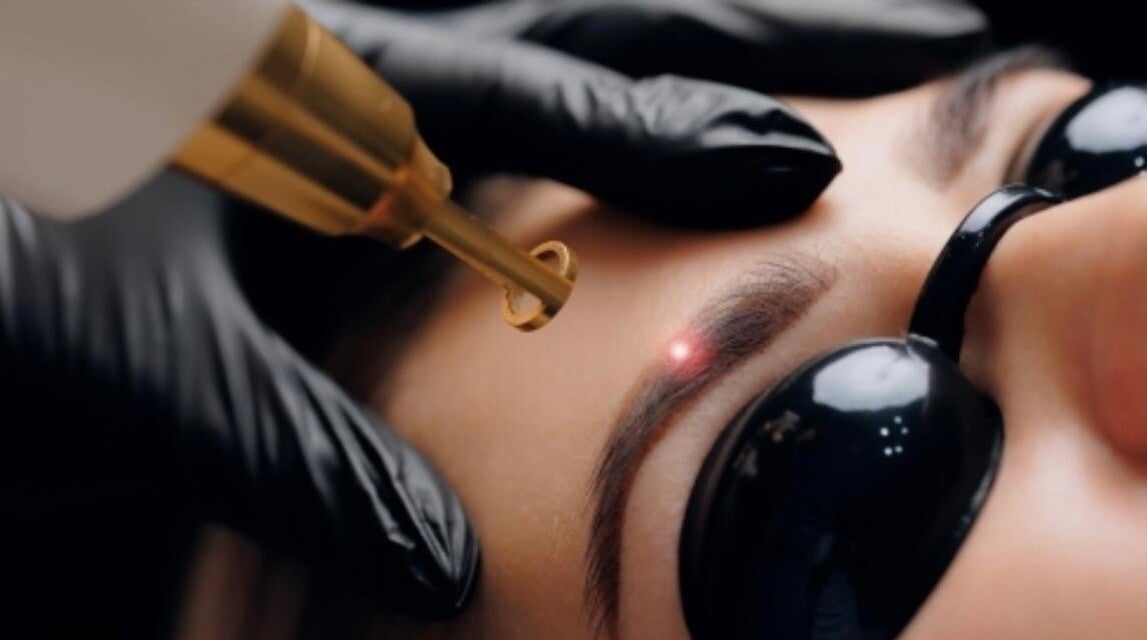
Define the Unwanted Area
The exact tail, front, arch or migrated section is agreed before treatment begins.
Pulsar Laser Studio · Selective eyebrow removal guide
Yes, selected areas such as an unwanted tail, heavy front, uneven arch, migrated pigment or colour outside the desired shape may sometimes be treated separately. This guide explains how selective removal works, its limitations and what to expect.
Jump to a section
The honest answer
Yes. Laser can be directed at a selected section rather than automatically treating the whole eyebrow tattoo.
Common examples include removing an overly long tail, reducing a square or heavy brow front, treating pigment outside the desired shape, correcting migrated pigment or softening one brow to improve balance.
The treatment boundary must be carefully planned because cosmetic pigment may change colour, fade unevenly or respond beyond the exact line that appears visible before treatment.
The exact tail, front, arch or migrated section is agreed before treatment begins.
A small test checks how the selected section responds and whether another colour appears.
The section is treated in stages so shape, colour and skin response can be reviewed.
Partial removal does not mean instant reshaping. The selected area may require several sessions and can temporarily become red, orange, yellow, darker or more noticeable before it fades.
Common selective-removal requests
A tail extending too far, too low or beyond the desired shape may be treated separately.
A dark, square or blocky front may be softened or selectively reduced.
One high, low, sharp or misplaced arch may be partially treated to improve balance.
Small sections sitting above, below or beyond the desired brow shape may be targeted.
Blurred or spread cosmetic pigment may be treated selectively where the colour is suitable.
The inner fronts may be reduced where the brow begins too close to the centre of the face.
One side may be treated more than the other where density, shape or colour differs.
Only the section limiting a future brow design may need removal.
Dense shading, overlapping strokes, colour correction and pigment extending beneath natural hair can make the true boundary less precise than it appears from the surface.
Selective laser treatment
A suitable wavelength is applied only to the agreed unwanted area. Responsive pigment absorbs the short laser pulse and larger pigment particles are fragmented into smaller pieces.
The body then gradually processes part of the fragmented pigment over the following weeks. The untreated section is left in place, although no treatment boundary is completely risk-free.
The client explains which section should remain and which section is unwanted.
Colour, density, technique, layering, migration, scarring and previous removal are reviewed.
A clear line is agreed around the section to be tested or treated.
A small area is tested for fading, colour change, darkening and skin response.
The immediate reaction settles and the true pigment response becomes clearer.
The unwanted section is treated in stages while the retained section is reviewed and protected as carefully as possible.
Precision matters
Selective removal depends on agreeing exactly which pigment should remain. The client and practitioner should review the brow from several angles before treatment begins.
Natural pigment shape must be visible without brow pencil, tint or concealer.
The client should clearly identify the section they dislike rather than relying only on verbal description.
Where redesign is planned, input from the future PMU artist can help define how much pigment needs removal.
Hair growth can hide pigment and affect how the new shape will look once the unwanted section fades.
The brow should be reviewed with the face relaxed and in normal expression.
It may be safer to remove slightly less at first and reassess after healing.
Clear images document the agreed line and pre-existing asymmetry.
The record should state exactly which section is being treated and why.
Pigment particles, skin healing and laser spot placement do not always create a perfectly sharp cosmetic boundary. A small transition zone may remain.
Improving balance without overpromising
Selective treatment can reduce pigment that contributes to asymmetry, but it cannot guarantee perfectly identical brows.
The longer or lower tail may be shortened to improve balance.
Pigment above or below the desired line may be selectively reduced.
A heavier, wider or more central front may be softened.
A misplaced peak may be reduced before redesign.
One brow may require more fading than the other.
One side may reveal red, orange or yellow before the other.
Bone structure, muscle movement and hair growth can remain different after pigment removal.
One side may be treated conservatively and reviewed before more pigment is removed.
The goal is improved balance, not guaranteed perfection. Some natural asymmetry is normal and may remain visible even after selective pigment reduction.
The treated section may not simply disappear
Yes. Cosmetic eyebrow pigments are often blends. The treated section may reveal red, orange, pink or yellow while the untreated section remains brown, grey or black.
| Visible change | What may be happening | Selective-removal concern |
|---|---|---|
| Dark brown becomes red | The dark component has reduced and warm pigment is now visible. | The treated section may temporarily contrast strongly with the retained brow. |
| Red becomes orange | Red pigment may be reducing while yellow remains. | More than one wavelength or treatment stage may be required. |
| Orange becomes yellow | A resistant yellow component may remain. | The final selective area may retain a pale yellow shadow. |
| Pale pigment becomes dark | White, beige or flesh-toned pigment may have darkened chemically. | The unwanted section can become more noticeable and may not be easily reversed. |
| Uneven colour across the border | Different pigment mixtures may sit on either side of the treatment line. | A visible transition may remain until further healing or treatment. |
The treated section may be brighter, darker or warmer during the course. Clients should be prepared for an intermediate stage that may need makeup camouflage once the skin has healed.
A small test before treating the whole unwanted section
Different areas may contain different pigment layers, depths and scar tissue. The patch reduces uncertainty but cannot remove every risk.
Treatment numbers
There is no fixed number. A small area is not automatically a one-session treatment.
Dense tails or block fronts usually take longer than faint superficial pigment.
Repeated top-ups can place several colours and depths in the same section.
Dark pigment may respond differently from red, orange, yellow or pale pigment.
Laser, saline or chemical treatment may alter response and healing.
A tiny tail correction may be quicker than reducing a large blocky front.
Intervals and settings must remain appropriate for the skin.
Softening for redesign may take fewer sessions than maximum possible clearance.
Treatment may stop with a faint yellow, pale or grey shadow.
Selective removal may finish once the future brow artist has enough space to redesign the shape. Complete clearance of every pigment particle may not be necessary.
Planning the next brow
Many clients do not need the whole eyebrow tattoo removed. The aim may be to create enough space for a more suitable shape.
Removing an overly long or downward tail can allow a new tail to be placed higher or shorter.
Reducing a heavy or central front can create a softer starting point.
Selected pigment may be removed to create room for a different peak.
Pigment above or below the desired line may be treated to narrow the brow.
Blurred pigment can be reduced before new work is considered.
One side may be selectively softened to create better balance.
Sections that remain well-shaped and suitable may be left in place.
Only treating what needs correction can reduce total skin exposure.
The skin must be fully healed and the remaining colour stable. New pigment placed too soon can increase trauma, create poor colour results and complicate future removal.
Balanced information
Swelling, neighbouring colour change, fading at the boundary and differences in pigment depth can temporarily alter the appearance of the whole brow.
Existing scar tissue may already be present. Repeated microblading, machine shading, correction and previous removal procedures can affect the final shape and texture.
Supporting precise healing
Always follow the individual instructions provided at your appointment. The guidance below is general.
Do not reshape the treated edge with makeup until the skin has healed. Once stable, temporary brow products may help disguise colour differences during the removal course.
Seek advice for increasing pain, spreading redness, increasing heat, pus, fever, significant swelling, eye symptoms, extensive blistering, delayed healing or any reaction that concerns you.
Your selective-removal journey
Photographs should show the whole face and a close-up of the exact section you want treated.
We assess colour, shape, symmetry, layering, previous treatment, skin and natural hair.
The section to remove and the section to keep are clearly marked and photographed.
A small area is tested for fading, colour change, darkening and skin response.
The immediate reaction settles before the full unwanted section is treated.
The agreed area is treated while unnecessary overlap is avoided.
The boundary, residual pigment and future design are reassessed after each session.
Treatment may finish when enough space has been created for redesign or when further laser is unlikely to help safely.
Continue learning
Eyebrows, eyeliner, colour changes, saline, sessions, risks and aftercare.
Read the cornerstone guide →How suitable laser energy fragments cosmetic pigment and why treatment is staged.
Read the laser guide →What affects treatment length and why the course may change.
Read the session guide →Temporary whitening, shedding, regrowth and permanent reduction risk.
Read the brow-hair guide →Why mixed cosmetic pigment reveals warmer colours.
Read the colour-change guide →Why white, beige and flesh-toned pigment may resist or darken.
Read the white pigment guide →Frequently asked questions
Yes. Selected sections can be treated separately where the colour, skin and treatment boundary are suitable.
Yes. An overly long, low or unwanted tail is a common selective-removal request.
Yes. A square, heavy or overly central front may be softened or reduced after assessment.
Selected pigment outside the desired shape may be treated if it can be safely isolated.
Yes. One brow may be treated more than the other where shape, colour or density differs.
It may improve balance, but perfect symmetry cannot be guaranteed because natural facial asymmetry and hair growth remain.
Not necessarily. A precise boundary is planned, but skin response and pigment distribution can create a small transition zone.
Overlap is a recognised risk. Careful marking and controlled treatment reduce it but cannot remove it completely.
It may reveal red, orange, pink or yellow, or pale pigment may darken unexpectedly.
It is not intentionally treated, but swelling, neighbouring response and small overlap can temporarily affect the overall appearance.
A patch test checks pigment response, colour change, darkening, skin healing and how precise the boundary appears.
There is no fixed number. Small light areas may respond quickly, while dense or layered pigment can require a longer course.
Complete clearance in one session is not realistic for most cosmetic tattoos.
Yes. Fading for redesign is often a suitable goal and may avoid unnecessary treatment of pigment that can remain.
Where possible, input from the future PMU artist can help define how much pigment needs removal.
No. The skin must be fully healed and the colour stable before a new procedure is considered.
Temporary whitening, singeing, breakage or shedding may occur, and permanent reduction is a recognised risk.
Yes. Scarring is a recognised risk, particularly where the skin is already scarred, treatment is too aggressive or healing skin is disturbed.
Yes. Yellow is often resistant and may remain as the safest endpoint.
Yes. Pale cosmetic pigment can darken to grey, blue-grey or black and may not be easy to reverse.
Not over broken, blistered, crusted or irritated skin. Once fully healed, temporary brow products may be suitable.
Not while the skin is healing. Wait until the area has fully recovered and the clinic confirms it is appropriate.
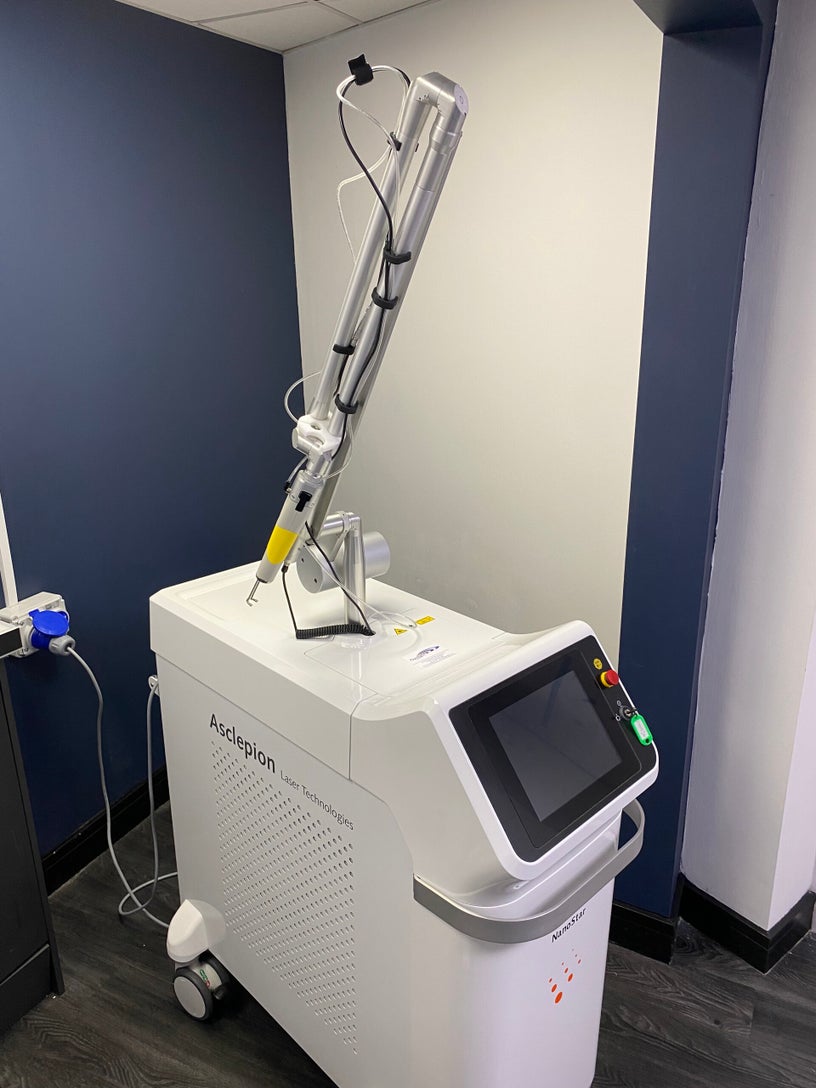
Pulsar performs selected partial eyebrow tattoo removal using the Asclepion NanoStar Y active Q-switched nanosecond laser at its Chorley clinic.
Start with an individual assessment
Send clear, makeup-free photographs showing the whole brow and the exact unwanted section, or book a consultation so we can assess the colour, shape, skin and safest selective-removal pathway.
Sources and further reading
This guide provides general information and does not replace an individual consultation, patch test or medical advice. Further reading: Laser Removal of Eyeliner and Eyebrow Tattoos: Experiences and Learnings; Lasers for the Treatment of Eyebrow Microblading and Cosmetic Tattoo Pigment: A Review; U.S. FDA — Tattoo Removal: Options and Results; U.S. FDA — Tattoos and Permanent Makeup Fact Sheet; North Bristol NHS Trust — Tattoo Laser Treatment.