

It May Not Absorb Well
White pigment reflects visible light and may not provide a strong target for commonly available tattoo-removal wavelengths.
Pulsar Laser Studio · White tattoo pigment guide
White tattoo ink is one of the most unpredictable pigments to treat. It may absorb tattoo-removal wavelengths poorly, remain unchanged or darken to grey, blue-grey, violet or black after laser exposure.
Jump to a section
The honest answer
Not in every case. White tattoo ink can be substantially more difficult and unpredictable than black or dark-grey pigment.
Some white pigments absorb the available laser wavelength poorly and show little useful fading. Others can undergo a chemical change and become darker after exposure. This response is known as paradoxical darkening.
A small patch test may provide useful information, but no responsible practitioner can guarantee that white ink will fade, remain unchanged or darken in a predictable way.

White pigment reflects visible light and may not provide a strong target for commonly available tattoo-removal wavelengths.
Titanium dioxide, zinc oxide and related pale compounds may change to a darker form after laser exposure.
Residual white, grey, blue-grey, violet or black pigment may remain even after staged treatment.
Darkening may create a visible target in some cases, but it does not guarantee that the altered pigment can then be cleared safely or completely.
The chemistry and optics are different
Laser tattoo removal relies on pigment absorbing an appropriate wavelength. White pigment is designed to reflect light and brighten other colours, which can make selective laser targeting difficult.
White pigment may reflect much of the incoming light rather than absorb enough energy for predictable fragmentation.
A common white pigment that can be resistant and may undergo a dark colour change after laser exposure.
Some white or cosmetic tattoo formulations may contain zinc compounds that can also behave unpredictably.
The exact manufacturer, ingredients and concentration are frequently unavailable by the time removal is requested.
White is often blended with red, blue, green, purple or yellow to create lighter shades.
Highlights, corrections and cover-ups may place white pigment over or beneath darker colours.
White highlights may be placed at a different depth from the surrounding tattoo and can fade unevenly.
White may be mixed into beige or flesh-tone pigment that can be difficult to distinguish from the surrounding skin.
The visible tattoo does not reveal the exact chemistry. Two areas that both look white can contain different ingredients and react very differently.
The main concern with pale pigment
Some white and pale tattoo pigments can undergo a chemical reduction after exposure to a short-pulse tattoo-removal laser. The treated pigment may become grey, blue-grey, violet, brown or black rather than fading.
This is called paradoxical darkening. It has been reported particularly in white, flesh-tone, tan, pink and cosmetic tattoo pigments containing titanium dioxide or iron oxides.
The reaction may be immediate, but the area must still be allowed to heal before the final colour and next step are assessed.
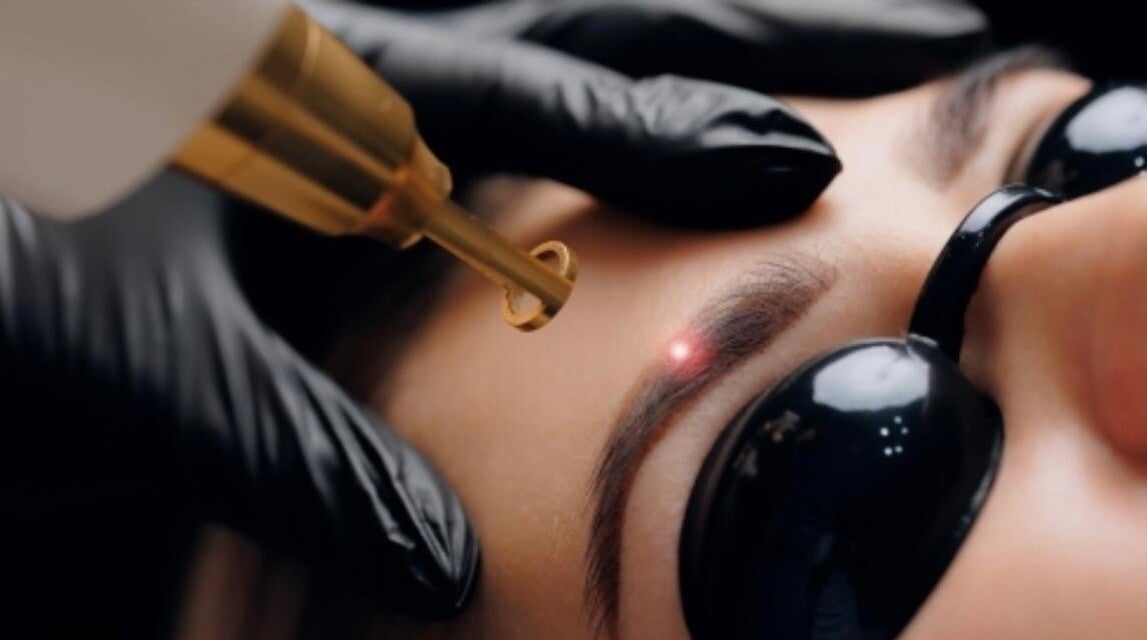
A test spot may turn darker as soon as the laser pulse is delivered.
Frosting, redness and swelling can temporarily affect the appearance, so the healed result matters.
Some darkened pigment may respond to later treatment, while some may remain resistant or become unsuitable for continued laser.
The pigment has changed appearance, but it has not necessarily been cleared. The altered colour may be more noticeable than the original white ink.
White may be present even when the tattoo is not visibly white
Tattoo artists commonly mix white into stronger colours to create highlights, opacity and pastel shades. A tattoo may therefore contain titanium dioxide or another pale pigment without having an obvious white section.
| Visible colour | Why white may be present | Possible laser behaviour | Planning consideration |
|---|---|---|---|
| Pink and pale red | White may be mixed with red to create pink or peach. | The red component may fade while pale residue remains or darkens. | Patch testing is important before broad treatment. |
| Light blue and turquoise | White may brighten or soften blue pigment. | The colour can be resistant, change shade or reveal a pale residue. | Another wavelength may still be needed for the blue component. |
| Mint and pale green | White may be blended with green or yellow. | Response may be limited or uneven. | Standard 1064 nm and 532 nm may not provide a suitable pathway. |
| Lavender and pastel purple | White may be mixed into red and blue components. | Different components may fade at different rates. | Several colours or an altered dark pigment may remain. |
| Yellow and cream | Titanium dioxide may be added to improve brightness or opacity. | The tattoo may resist treatment or darken. | Repeated treatment without a useful response can increase skin risk. |
| Beige, tan and flesh tone | White may be blended with yellow, red, brown and iron oxides. | Paradoxical darkening is a recognised risk. | Often seen in permanent makeup and camouflage tattooing. |
Pastel does not mean easy. A light-looking tattoo may be more complex to treat than a dark tattoo because several pigments and reflective white components can be present.
Testing a small area first
A patch test cannot predict every future treatment response, but it can reveal whether a small section darkens immediately, shows no meaningful response or develops an unexpected skin reaction.
The test may reveal a grey, blue-grey, violet, brown or black colour change.
A lack of visible reaction may indicate that the pigment is not absorbing the selected wavelength meaningfully.
The skin response, blistering, pigment change and texture must be reviewed after adequate healing.
Testing limits the size of a potentially undesirable colour change before any full-area decision is made.
The cosmetic impact of widespread darkening can be significant, particularly on the face, eyebrows, lips, scars or visible body areas.
The next step depends on the healed result
The area should not be immediately retreated. The skin and altered pigment need time to settle before the practitioner decides whether another wavelength, further patch testing or a non-laser pathway is appropriate.
Clear photographs and treatment records should show the location, settings and immediate colour change.
Redness, swelling, frosting, blistering or crusting must fully settle before the altered pigment is judged.
The area may remain grey, violet, brown or black, or the initial appearance may soften as inflammation resolves.
If a clearly dark target remains, a carefully selected later test may be considered rather than treating the whole area.
Further laser is not justified when repeated tests show little clearance or the surrounding skin is becoming compromised.
Depending on the site and tattoo, medical dermatology, surgical, ablative, camouflage or specialist correction advice may be more appropriate.
Some clinical reports describe successful staged treatment of darkened pigment, while the U.S. FDA cautions that oxidised white or flesh-tone pigment may become untreatable by laser. Individual assessment is therefore essential.
More energy cannot correct poor absorption
No. Fluence must be selected for a suitable pigment target and surrounding skin. Increasing energy cannot force reflective or chemically resistant pigment to respond safely.
Excess energy can create unintended thermal injury to the surrounding tissue.
A stronger skin reaction does not prove that more pigment will clear.
Higher energy may increase unwanted lightening or darkening of the surrounding skin.
Repeated injury can increase the risk of permanent texture change without delivering meaningful white-ink removal.
The correct endpoint may be to stop. When no useful pigment response is demonstrated, declining further treatment can be safer than repeatedly escalating the settings.
A cautious, consultation-led pathway
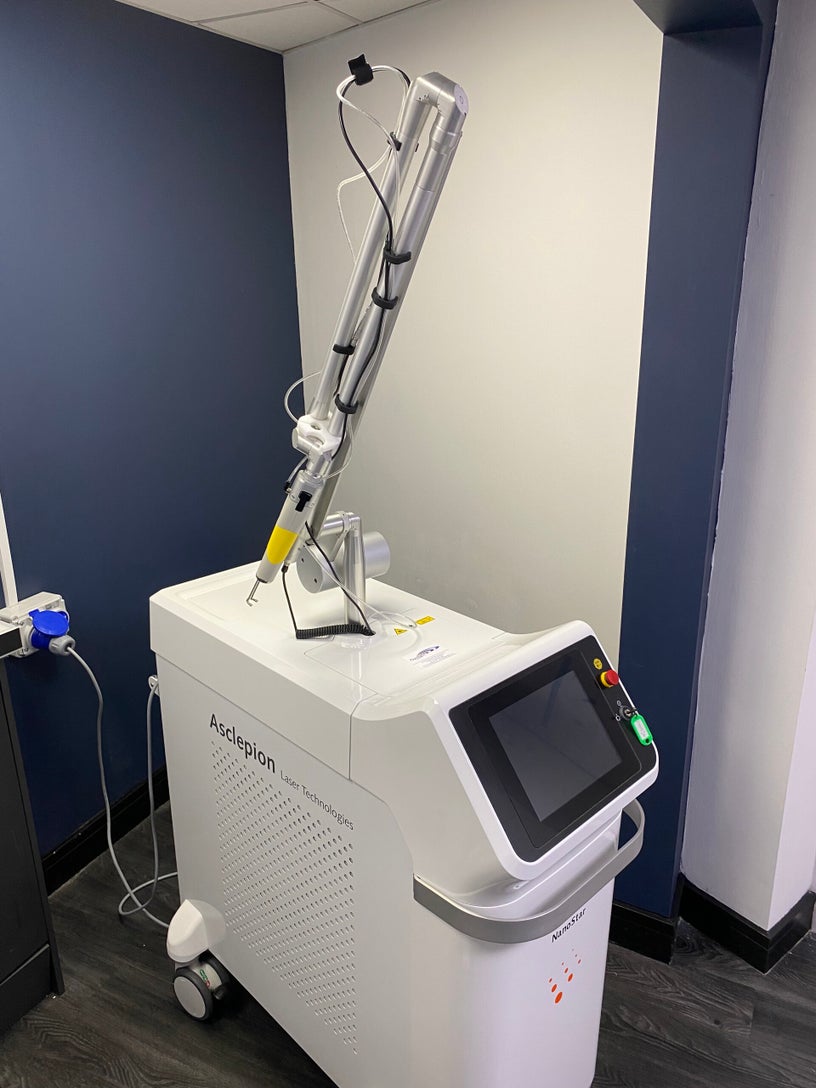
Pulsar uses the German-engineered Asclepion NanoStar Y active Q-switched nanosecond laser at its Chorley clinic. The system provides 1064 nm and 532 nm wavelengths for suitable pigment indications.
We do not claim that these wavelengths can reliably remove every white, pastel or flesh-tone pigment. Pulse duration alone, whether nanosecond or picosecond, does not solve poor absorption or the risk of chemical darkening.
Where white or pale pigment is visible or suspected, the decision may be to patch test, postpone, refer or decline treatment.
We ask about tattoo age, colours, highlights, cover-ups, pigment brands if known and any previous laser response.
Pastel, pink, pale blue, mint, cream, beige and flesh-tone sections are assessed for possible white pigment content.
Skin type, tanning, medication, healing history and previous pigment or texture changes are reviewed.
The possibility of a more visible grey, violet, brown or black result is discussed before any test is performed.
A small area may be tested and allowed to heal fully before any larger treatment decision.
Further treatment only proceeds where there is a suitable target, acceptable healing and a realistic prospect of benefit.
A dermatologist, specialist laser provider or another qualified practitioner may be more appropriate for complex pigment or scar camouflage.
We will not repeatedly treat resistant pigment simply because some colour remains visible.
Honest limitation: Pulsar may decline white-ink treatment where the expected benefit is low or the cosmetic risk of darkening is unacceptable.
When laser is not the right answer
No alternative guarantees clean, scar-free removal. Methods that physically remove or injure the skin can carry a higher risk of permanent texture change and should only be assessed by an appropriately qualified professional.
Small white highlights may become less noticeable as the tattoo ages or may be incorporated into a future design.
A skilled tattoo artist may assess whether the pale section can be incorporated or covered safely.
Small areas may occasionally be assessed for surgical removal, with an expected scar replacing the tattoo.
A medical specialist may consider an ablative approach in selected cases, but scarring and pigment change are recognised risks.
Unregulated creams, acids, salt abrasion and home-removal methods do not selectively remove dermal tattoo pigment and can cause burns, infection, permanent discoloration and scarring.
Frequently asked questions
Not reliably in every case. White pigment may remain resistant, show little response or darken after laser exposure. Complete clearance cannot be guaranteed.
Some white pigments contain titanium dioxide, zinc oxide or related compounds that can undergo a chemical change and become grey, violet or black after exposure.
It is an unexpected dark colour change in pale, white, flesh-tone, pink or cosmetic pigment after laser treatment rather than the intended fading.
No. Formulations vary, and the exact ingredients are often unknown. Titanium dioxide is common, but visual appearance alone cannot confirm the formula.
Some white or cosmetic pigments may contain zinc compounds. The manufacturer’s ingredient information is useful when available, but it may not fully predict the laser response.
Sometimes a healed dark target may be assessed for further staged treatment, but success is not guaranteed. Some oxidised pigment may remain resistant or unsuitable for further laser.
It can occur immediately after the laser pulse, although frosting, redness and swelling can affect the early appearance. The healed result must be reviewed.
No. A patch test does not prevent the reaction; it limits the test area and provides information before a larger section is considered.
No. Different sections may contain different pigment concentrations, brands, layers or depths.
Yes. Pink is often created by mixing red with white, so the red component may fade while pale pigment remains or darkens.
Yes. White may be used to brighten or soften blue pigment, making the laser response more complex and unpredictable.
Yes. Titanium dioxide may be used to improve brightness and opacity in some yellow formulations, which may contribute to resistance or darkening.
Cosmetic white, beige and flesh-tone pigments can be particularly unpredictable. Consultation and patch testing are essential, and treatment may be declined.
Not automatically. Picosecond describes pulse duration, but white-ink behaviour still depends on wavelength, pigment chemistry, energy delivery and the surrounding skin.
No. More energy cannot replace suitable absorption and may increase burns, blistering, pigment change, texture change and scarring.
Possibly, but the same risks of resistance and darkening apply. A tattoo artist should be involved in deciding whether treatment is necessary.
Small areas may sometimes be assessed for surgical excision, but this replaces the tattooed skin with a surgical scar and requires medical evaluation.
No approved cream selectively removes dermal white tattoo pigment. DIY acids and removal products can cause burns, infection, discoloration and scarring.
No. Pulsar assesses each case individually and may decline treatment where the expected benefit is low or the risk of darkening and skin injury is too high.
No. Pulsar uses the German-engineered Asclepion NanoStar Y active Q-switched nanosecond laser with 1064 nm and 532 nm wavelengths.
Continue reading
Why wavelength, pigment composition and visible colour affect removal.
Read article →How darker cosmetic pigment can reveal red, orange, pink or yellow tones.
Read article →Why pulse duration is only one part of a complete tattoo-removal system.
Read article →Recognised risks, existing tattoo texture and ways to reduce avoidable complications.
Read article →How to protect the treated skin and recognise warning signs.
Read article →How controlled fading can create more flexibility for a future tattoo design.
Read article →Start with an honest pigment assessment
Send clear photographs in natural light, measurements and any known pigment information. We will explain whether a patch test may be appropriate and why treatment may sometimes be declined.
Sources and further reading
This guide provides general information and does not replace an individual consultation, patch test or medical assessment. White, pale and cosmetic tattoo formulations vary, and their exact ingredients are frequently unknown. Further reading: U.S. FDA — Tattoo Removal Options and Results; Laser Tattoo Removal Review; Complications of Tattoos and Tattoo Removal; Laser Tattoo Removal: A Clinical Update; Titanium Dioxide and Laser Tattoo Removal.