

Picosecond Advantage
Shorter pulses may create a stronger photoacoustic or mechanical effect and can improve clearance for selected pigments or tattoos.
Pulsar Laser Studio · Tattoo-removal technology guide
Picosecond pulses are shorter than nanosecond pulses, but pulse duration is only one part of a complete tattoo-removal system. Wavelength, delivered energy, fluence, spot size, beam quality, tattoo pigment, skin type, practitioner technique and healing intervals all influence safety and results.
Jump to a section
The balanced answer
No. Picosecond technology can offer advantages for some tattoos and pigments, and research has reported improved clearance in certain comparisons. Other studies have found little or no clinically meaningful advantage for particular wavelengths, tattoo colours or treatment conditions.
Active Q-switched nanosecond lasers have been established tattoo-removal systems for decades and remain capable of substantial fading and clearance in suitable tattoos.
The most useful question is not simply, “Is it pico or nano?” It is: Does this exact system provide the correct wavelength, stable energy, suitable spot size, consistent beam profile and safe treatment pathway for my tattoo and skin?

Shorter pulses may create a stronger photoacoustic or mechanical effect and can improve clearance for selected pigments or tattoos.
Medical-grade active Q-switched nanosecond systems remain proven, effective technology for suitable tattoo pigment.
Pulse duration should be considered alongside wavelength, output quality, tattoo characteristics, skin and practitioner expertise.
The terminology is often misunderstood
A common source of confusion is treating terms such as Nd:YAG, Q-switched, nanosecond and picosecond as if they describe competing types of laser. They describe different parts of the system.
A picosecond laser can also be Nd:YAG. For example, a system may be described as a picosecond Q-switched Nd:YAG laser. “Pico” does not mean “not Nd:YAG”, and “Q-switched” does not automatically mean nanosecond.
What the words mean
Nanosecond pulses are measured in billionths of a second. Active Q-switched nanosecond lasers deliver high-energy pulses in extremely short bursts and have a long clinical history in tattoo removal.
Picosecond pulses are measured in trillionths of a second. These shorter pulses can increase peak power and place greater emphasis on photoacoustic or mechanical fragmentation when the other system parameters are appropriate.
A shorter pulse is not a different wavelength. A 1064 nm picosecond laser and a 1064 nm nanosecond laser both emit 1064 nm light. Their pulse duration differs, but colour suitability remains strongly influenced by wavelength.
Side-by-side overview
Both nanosecond and picosecond systems can be highly effective tattoo-removal technologies. Their main distinction is pulse duration, while wavelength, energy delivery, beam quality and the individual tattoo remain critical to the clinical result.
← Swipe across to compare both technologies →
| Feature | Active Q-switched nanosecond | Picosecond |
|---|---|---|
| Pulse duration | Ultra-short pulses measured in billionths of a second | Even shorter pulses measured in trillionths of a second |
| Technology | Established high-energy photoacoustic tattoo-removal technology | Further development of ultra-short-pulse tattoo-removal technology |
| Laser medium | Can include Nd:YAG, ruby and alexandrite systems | Can also include Nd:YAG, alexandrite and other engineered laser platforms |
| Pigment interaction | Strong photoacoustic/mechanical pigment fragmentation with a photothermal component | Greater emphasis on photoacoustic/mechanical fragmentation due to the shorter pulse |
| Black & dark pigment | 1064 nm Q-switched Nd:YAG has a long clinical history and can provide excellent clearance in suitable tattoos | 1064 nm picosecond systems can also provide excellent clearance in suitable tattoos |
| Red & warm pigment | Suitable 532 nm systems can effectively target many red, orange and warm pigments | Suitable 532 nm picosecond systems can also effectively target these pigments |
| Blue & green pigment | Selected shades may require specialist wavelengths such as 694 nm ruby or 755 nm alexandrite | Selected shades may also benefit from specialist wavelengths such as 694 nm or 755 nm |
| Clinical strengths | Established performance, high pulse energy, proven wavelengths and strong results when delivered by a quality system | Shorter pulse duration may provide an advantage for selected resistant pigments and tattoo types |
| Number of sessions | Usually requires a course; response varies considerably between tattoos | Also usually requires a course; some studies report faster clearance in selected cases |
| What determines results? | The complete laser system: wavelength, pulse duration, energy, fluence, spot size, beam quality, tattoo pigment, skin type and practitioner technique | |
| Recognised risks | Temporary swelling, blistering and pigment change can occur; burns, texture change, infection and scarring are less common recognised risks | The same recognised treatment risks remain possible |
The complete system matters
The pigment must absorb it. One wavelength cannot treat every tattoo colour.
The laser must provide stable, clinically useful output rather than relying on a headline specification alone.
Energy per unit area must be appropriate for pigment, spot size, skin and treatment endpoint.
It influences depth, scattering, coverage and the fluence available at the skin.
A consistent beam helps deliver energy evenly and reduces unnecessary hot spots.
Settings must protect surrounding melanin as well as target tattoo pigment.
Assessment, overlap, endpoint recognition, parameter selection and aftercare all matter.
Skin recovery and the body's gradual pigment-clearance process cannot be rushed.
Ask for the exact manufacturer and model, the manufacturer-documented or independently verified pulse duration where available, the wavelengths the system actually produces, regulatory status, service support and practitioner training. A marketing label or touchscreen menu does not describe the complete technical capability of a laser.
Colour capability depends heavily on wavelength
Potentially, but only when the system includes a wavelength appropriate for the pigment. Pulse duration alone does not make 1064 nm suitable for every green, turquoise or light-blue tattoo.
Selected blue and green pigments may respond better to 755 nm alexandrite or 694 nm ruby wavelengths. These wavelengths can exist in nanosecond or picosecond platforms.
Black and blue-black pigment often suits 1064 nm, while many red or orange pigments may suit 532 nm, whether delivered in the nanosecond or picosecond range.

Simple rule: Pulse duration influences how energy is delivered. Wavelength strongly influences which pigments are most likely to absorb that energy.
What the evidence means
Some comparative studies have found greater or faster clearance with picosecond systems for selected tattoos, while other comparisons have found little or no significant advantage for specific wavelengths and tattoo types. That does not mean every tattoo clears in fewer sessions or that complete removal is guaranteed.
Residual pigment, shadowing, resistant colour, colour change or pre-existing scar texture may remain after either nanosecond or picosecond treatment.
Our technology explained clearly
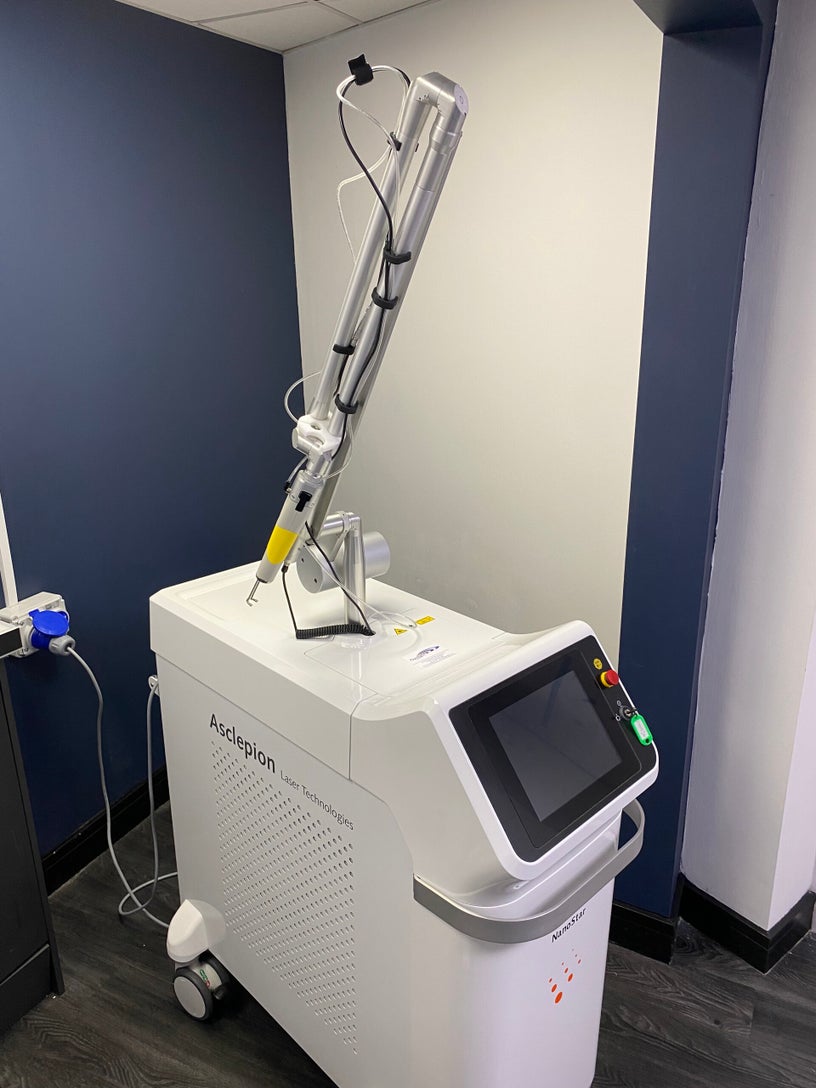
Pulsar uses the Asclepion NanoStar Y active Q-switched nanosecond Nd:YAG laser at its Chorley clinic. We do not market this system as a picosecond laser.
The NanoStar Y provides 1064 nm and 532 nm wavelengths for suitable tattoo and pigment indications. Asclepion describes the system as using Q-switched technology and its OptiBeam beam-delivery concept.
Our choice is based on an established professional laser platform with defined wavelengths, controlled energy delivery, manufacturer support and a consultation-led treatment pathway.
Honest treatment planning: We would rather explain a limitation or refer a pigment needing another wavelength than sell a course unlikely to provide meaningful benefit.
Frequently asked questions
No. It may provide advantages for selected tattoos, but results also depend on wavelength, energy delivery, spot size, beam quality, pigment, skin and technique.
Yes. Active Q-switched nanosecond lasers have a long clinical history and can achieve substantial fading or clearance in suitable pigments.
Yes. Nd:YAG describes the laser gain medium, while picosecond describes pulse duration. A laser can therefore be both Nd:YAG and picosecond.
No. Q-switching describes a method used to generate short, high-energy pulses. Nanosecond describes how long the pulse lasts. Some picosecond tattoo-removal lasers are also described as Q-switched.
No. Complete removal in one session is not realistic for most tattoos.
No. Picosecond describes pulse duration. The system still needs a wavelength appropriate for the pigment being treated.
No. Wavelength and pulse duration are separate specifications. A 755 nm system may operate with different pulse durations depending on the device.
Not necessarily. Ruby commonly refers to a 694 nm wavelength and can exist in different pulse formats.
Ask for the manufacturer and exact model of the laser. The manufacturer's technical specification should identify the wavelengths and pulse-duration range. Marketing terminology alone does not describe the complete system.
Pulsar selected the Asclepion NanoStar Y as an established active Q-switched professional laser platform with defined 1064 nm and 532 nm wavelengths and manufacturer support.
Blue-black and some darker blue pigments may be suitable for assessment. Light blue, turquoise and many true green pigments may require 755 nm alexandrite or 694 nm ruby technology.
Some studies report advantages for picosecond technology in particular treatment settings, but neither pulse duration is risk-free. Device quality, wavelength, settings, skin type, technique and aftercare remain essential.
Continue reading
How treatment works, colours, risks, sessions and aftercare.
Read guide →Why wavelength and pigment composition affect different colours.
Read article →Why density, depth, layering and your goal affect the course.
Read article →Recognised risks and ways to reduce avoidable complications.
Read article →Why healing and pigment processing cannot be rushed.
Read article →How to protect the treated skin after each session.
Read article →Choose the right pathway, not just a label
Send clear photographs with measurements or book a consultation. We will assess the colours, density, layering, skin type and whether Pulsar’s 1064 nm and 532 nm nanosecond pathway is suitable.
Sources and further reading
This guide provides general information and does not replace an individual consultation, patch test or medical assessment. Further reading: Laser Tattoo Removal: A Clinical Update; Optimising Laser Tattoo Removal; Lasers in Tattoo and Pigmentation Control; Prospective Picosecond vs Nanosecond Comparison; Picosecond Q-Switched Nd:YAG Tattoo Removal; Asclepion NanoStar Technology.