

Screen the Eyes
Eye health, surgery, medication, symptoms and contact-lens history are reviewed.
Pulsar Laser Studio · Permanent eyeliner removal guide
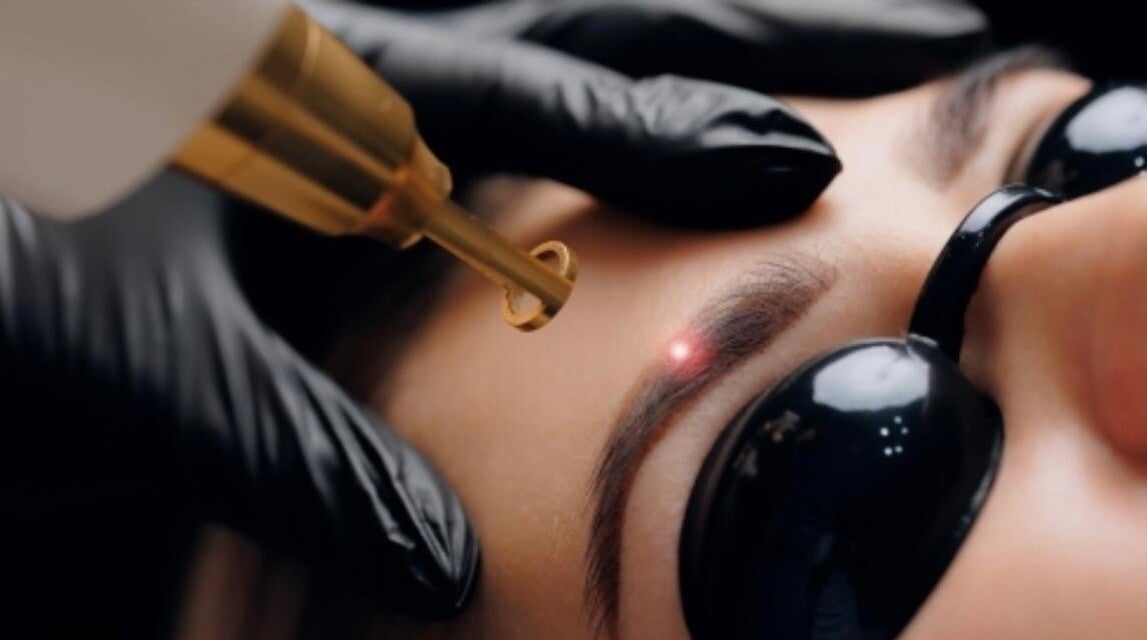
Selected permanent eyeliner tattoos can be reduced with laser, but treatment sits directly beside the eye and requires a specialist safety pathway. At Pulsar, eyeliner laser treatment is only performed with correctly fitted internal metal ocular shields, suitable patient selection and a patch test.
Jump to a section
The honest answer
Yes, selected permanent eyeliner can be reduced with laser when the pigment, eyelid anatomy, skin type, eye history and patch-test response are suitable.
However, eyeliner is not treated like an ordinary facial tattoo. The pigment may sit on the upper or lower eyelid and can extend close to the lash line. The eye itself must therefore be protected from direct and reflected laser energy.
At Pulsar, external goggles alone are not used as the sole protection for eyeliner treatment. Correctly sized internal metal ocular shields are placed over the eyes before any laser pulse is delivered to the eyelid.
Eye health, surgery, medication, symptoms and contact-lens history are reviewed.
Internal metal ocular shields are fitted before the eyelid is treated.
The healed colour and eyelid response determine whether treatment continues.
Closing the eyes, using cotton pads or relying only on ordinary external eyewear is not an acceptable substitute when the laser is delivered directly to the eyelid.
Why this treatment is different
The treatment area is on thin eyelid skin immediately over the eye.
Ink may sit between, above or below natural lashes.
Eyelid skin has less tissue between the pigment and underlying structures.
The practitioner must be trained to select, insert, check and remove internal shields.
Black eyeliner may contain red, blue, green, yellow, white or other ingredients.
Eyelashes can temporarily whiten, singe, break or shed.
Previous surgery and current eye disease may alter suitability.
Eye pain, visual disturbance or light sensitivity after treatment requires urgent assessment.
The central safety measure
Internal ocular shields are smooth, curved protective devices designed to sit over the surface of the eye beneath the closed eyelids. They create an opaque physical barrier between the laser and the eye.
The correct size and fit matter. A shield must sit securely and comfortably over the eye. A poorly fitted, damaged or incorrectly handled shield can create avoidable risk.
What happens at the appointment?
No contact lens should remain in the treated eye during shield placement or laser treatment.
Current redness, discharge, injury, pain or other signs that may delay treatment are assessed.
Suitable ophthalmic drops are used to numb the eye surface where permitted by the treatment protocol.
Sterile ophthalmic lubricant helps the shield sit smoothly and reduces friction.
The eyelids are gently controlled while the shield is placed over the eye by a trained practitioner.
The shield must fully cover the eye and remain stable before treatment begins.
The eyelid remains closed over the shield while carefully controlled laser pulses are delivered.
After treatment, the shield is removed gently and the client is asked about comfort and vision.
Pressure, awareness or an unusual sensation may occur, but sharp pain, sudden visual change or severe discomfort must be reported immediately.
Which eyeliner tattoos may be considered?
Selected pigment above or through the upper lash line may be assessed.
Selected pigment below the lower lash line may be assessed separately.
Unwanted wings or extended tails may sometimes be treated selectively.
Dense eyeliner may be reducible but often needs a staged course.
Dark residual pigment may provide a suitable initial laser target.
Suitability depends on the true colour, pigment depth and available wavelength.
Red, orange, yellow, green or blue stages require separate reassessment.
Selected migration, uneven edges or unwanted sections may sometimes be reduced.
Treatment may be declined where pigment lies in an unsafe position, the eye cannot be protected adequately, current eye symptoms are present, the medical history creates concern or the pigment response is unsuitable.
Information we need before treatment
Laser treatment should not proceed over an unexplained painful, red, infected or visually disturbed eye. Medical or ophthalmic clearance may be required before a future appointment.
Before a full eyeliner treatment
Internal ocular protection is still required for a patch test on the eyelid. A smaller treatment area does not remove the need to protect the eye.
How eyeliner pigment is reduced
A suitable wavelength delivers a very short pulse of energy into responsive pigment within the eyelid skin. The pigment absorbs the pulse and larger particles are fragmented into smaller pieces.
The body then gradually processes part of the fragmented pigment over the following weeks. The eyeliner does not simply wipe away or disappear during the appointment.
Colour, density, position, depth, migration and eyelid condition are reviewed.
Correctly fitted metal ocular shields are placed before the eyelid is exposed to laser.
The wavelength must suit the currently visible pigment and surrounding skin.
Larger pigment particles are fragmented while surrounding exposure is controlled.
Frosting, redness, swelling, warmth or temporary colour change may occur.
The surface settles while pigment clearance continues beneath it.
The next treatment decision is based on the fully healed result.
Why black eyeliner may reveal another colour
Cosmetic eyeliner pigments may be blended to create a softer black, charcoal, brown or coloured finish. Laser may reduce one ingredient before another becomes visible.
| Visible stage | What may be happening | Possible next step |
|---|---|---|
| Black or charcoal | The dark component dominates before treatment. | A wavelength suitable for dark pigment may be considered. |
| Red or pink | A warm ingredient or older pigment layer has become visible. | A different wavelength may be considered after full healing. |
| Orange | Red and yellow components may remain together. | Further treatment depends on the healed colour and skin type. |
| Yellow | A resistant yellow component may remain. | Laser benefit may become limited and treatment may need to stop. |
| Blue or green | A cooler pigment component has become more visible. | Available wavelengths and eye-area suitability must be reviewed. |
| Grey, blue-grey or black darkening | White, beige or flesh-toned pigment may have changed chemically. | Pause treatment and review the fully healed patch. |
A colour change can mean a darker component has reduced. It does not automatically mean the treatment has failed, but it may change the wavelength, expectations or safe endpoint.
Treatment numbers and intervals
There is no reliable fixed number. Faint black eyeliner may respond differently from dense wings, repeated top-ups, migrated pigment or liner containing several colour components.
Black, grey, red, orange, yellow, blue, green and pale pigment respond differently.
Dense or repeatedly reinforced liner generally requires more treatment.
Deep or uneven pigment may fade slowly or remain as a shadow.
Anatomy, position and treatment access can affect the plan.
Several appointments can create mixed layers and colours.
White, beige, yellow or flesh-toned additions can complicate removal.
The eyelid must recover fully before another treatment is considered.
Softening a wing or reducing density may take fewer sessions than maximum clearance.
Complete removal cannot be guaranteed. A successful outcome may be substantial fading, correction of an unwanted section or a safer, softer appearance.
Immediate and early appearance
A temporary white surface reaction may appear over responsive pigment.
The treated eyelid may look pink or red for a short period.
Puffiness can make the eyelid look heavier or temporarily uneven.
The eye may water following shield removal or eyelid treatment.
Mild soreness or sensitivity may occur as the skin settles.
Dryness or light crusting may develop during healing.
The eyeliner may temporarily look redder, brighter or more uneven.
Eyelashes can temporarily look white, blonde, singed or shortened.
Severe eye pain, persistent blurred vision, marked light sensitivity, increasing redness of the eye itself or a sudden visual change requires urgent medical assessment.
Balanced safety information
Internal shields reduce risk but do not make poor technique safe. Treatment requires appropriate training, correct shield handling, controlled settings and immediate action if concerning eye symptoms occur.
When treatment may be delayed or declined
Conjunctivitis, discharge, significant blepharitis or other infection must settle first.
Pain, redness, visual change or strong light sensitivity requires medical assessment.
Medical or ophthalmic clearance may be needed before shield placement.
Treatment cannot proceed if the eye cannot be protected securely.
Pigment inside the wet line or in an inaccessible area may be unsuitable.
Unexpected darkening, excessive injury or poor healing may stop treatment.
Sun or tanning exposure can increase the risk of pigmentary skin changes.
Treatment may be declined where complete clearance is demanded despite resistant pigment.
Supporting eyelid recovery
Always follow the individual instructions provided at your appointment. The guidance below is general.
Urgent medical assessment is needed for severe or increasing eye pain, persistent blurred or reduced vision, marked light sensitivity, increasing redness of the eye, inability to open the eye, pus-like discharge or any sudden visual disturbance.
Your treatment journey
Photographs with the eyes gently closed provide an initial view of colour, width, wings and migration.
We review pigment history, eye health, surgery, medication, skin and treatment expectations.
The eyes and eyelids must be suitable for safe internal ocular protection.
A small section is tested while the eye remains protected by an internal shield.
The pigment colour, eyelid skin and any eye irritation are reviewed after recovery.
The agreed section is treated with internal shields in place throughout laser exposure.
The wavelength and plan may change if another pigment colour becomes visible.
Treatment ends when the goal is achieved or further laser is no longer safe or useful.
Continue learning
Eyebrows, eyeliner, lip blush, colour changes, risks and aftercare.
Read the cornerstone guide →How short laser pulses fragment suitable cosmetic pigment and why treatment is staged.
Read the laser guide →How blended pigment can reveal warmer or unexpected colours during removal.
Read the colour-change guide →Why white, beige and flesh-toned pigment can resist treatment or darken.
Read the white-pigment guide →Why pigment colour, depth, density and top-ups affect treatment length.
Read the session guide →How to distinguish immediate reactions from fully healed treatment outcomes.
Read the results guide →Frequently asked questions
Selected permanent eyeliner can be reduced where pigment colour, eyelid anatomy, skin type, eye history and patch-test response are suitable.
It can be performed with an appropriate specialist pathway, but treatment beside the eye carries serious risks and requires correct internal ocular protection, training and patient selection.
At Pulsar, internal metal ocular shields are required whenever laser is delivered to permanent eyeliner on the eyelid. External goggles alone are not used as the sole protection.
No. Closing the eyes does not protect the eye adequately from laser energy delivered through the eyelid.
Not when the eyeliner beneath or immediately beside the goggles must be treated. The eye itself requires an internal opaque barrier.
The eye is numbed and lubricated before insertion. Pressure or awareness may be felt, but sharp pain should be reported immediately.
Corneal abrasion or irritation is a recognised risk. Correct sizing, lubrication, insertion and removal are important.
Serious eye injury is possible if laser reaches the eye. This is why internal shielding and specialist technique are essential. Any visual disturbance after treatment needs urgent assessment.
Possibly, but the date, recovery and surgeon’s advice must be reviewed. Recent surgery may require ophthalmic clearance.
Possibly, but your surgery and eye health must be disclosed and medical clearance may be required.
No. Contact lenses must be removed before internal shields are inserted.
Selected upper and lower liner may be assessed, but suitability depends on pigment position, anatomy, eye protection and healing.
Pigment in or extremely close to the inner wet line may be unsuitable. The exact position must be assessed in person.
Yes, selected wings or extended tails may sometimes be treated separately where a safe boundary can be created.
Yes. Red, orange, yellow, blue or green ingredients may become visible as dark pigment reduces.
Yes. White, beige and flesh-toned cosmetic pigment can darken to grey, blue-grey or black after laser exposure.
A protected patch test checks pigment response, colour change, unexpected darkening, eyelid healing and lash effects.
Yes. Treating a smaller area of eyelid does not remove the need to protect the eye.
Complete removal in one session is not realistic for most cases. Treatment is normally staged.
The number depends on colour, depth, density, top-ups, position, skin response and your final goal.
Temporary whitening, singeing, breakage or shedding may occur. Permanent reduction is a recognised risk.
Mild eyelid redness, swelling, tenderness, watering, temporary frosting and colour change may occur and should improve.
Seek urgent assessment for severe eye pain, persistent blurred or reduced vision, marked light sensitivity, increasing redness of the eye or any sudden visual change.
No. Residual yellow, pale, blue, green, grey or shadow pigment may remain.
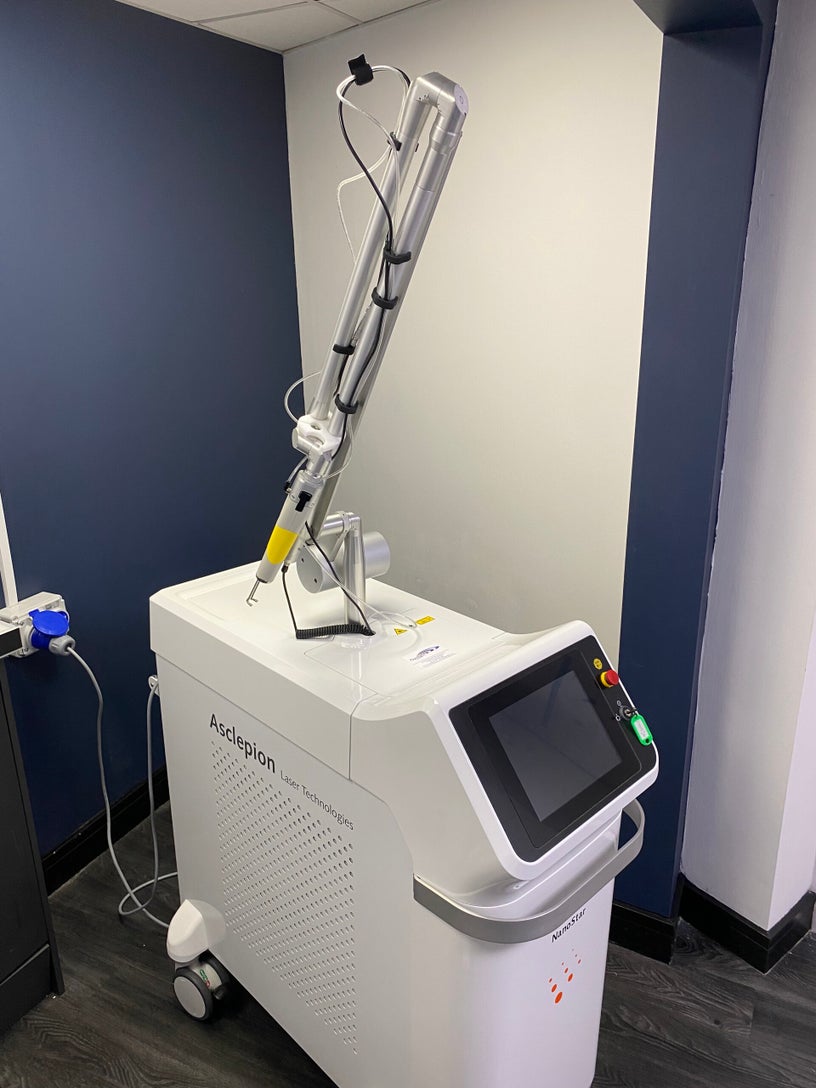
Pulsar performs selected eyeliner tattoo removal using the Asclepion NanoStar Y active Q-switched nanosecond laser and internal metal ocular shields at its Chorley clinic.
Start with a specialist assessment
Send clear, makeup-free photographs with your eyes gently closed or book a consultation so we can assess the pigment position, colour, eye history, shield suitability and safest removal pathway.
Sources and further reading
This guide provides general information and does not replace an individual consultation, protected patch test, ophthalmic assessment or medical advice. Further reading: Laser Removal of Eyeliner and Eyebrow Tattoos: Chart Review, Experiences and Learnings; Lasers for the Treatment of Eyebrow Microblading and Cosmetic Tattoo Pigment: A Review; U.S. FDA — Tattoo Removal: Options and Results; U.S. FDA — Tattoos and Permanent Makeup Fact Sheet; North Bristol NHS Trust — Tattoo Laser Treatment.